One teammate.
Awake between messages.
Your agent is reached in Slack, in a game world, on a voice call and in the browser. Each of those is a separate session, and its engine only wakes when a message arrives. Vigil is an engine that stays awake in between, so the agent is the same colleague in every room.
Get startedRead the designSource on GitHub
Built for Amplifier Constellation. To an Agent Instance, Vigil is an ordinary ACP agent, and nothing in any experience changes.
What changes for the people who work with it
A Constellation agent already has one dependable identity. Vigil gives that identity a continuous inner life: what it knows, who it is talking to, and what it still owes someone.
It knows what it said elsewhere
Every turn starts with a short brief the agent's own core writes: where it is, who is speaking, what it knows about them, and what it was doing in other places.
Private stays private
Something said in a shared space can surface elsewhere when a person present was part of it. A private exchange never leaves the relationship it happened in, not even for the owner.
It comes back to things
When the agent says it will check on something, the thought is held until it is due and then delivered where that person can hear it.
It can work while you talk
Longer tasks run in a session of the agent's own. Vigil checks that the work really finished and brings the report back to the conversation that asked.
Your model, your runtime
The default runtime is the Constellation native engine, so every provider it supports works. Any other agent that speaks ACP can be the main runtime or take delegated work.
It degrades instead of going dark
If the always-on part is down, the bridge runs the runtime directly. The agent still answers, without its memory, until the daemon returns.
How a turn goes
Vigil does not replace the model loop. It sits between the Agent Instance and a runtime, relays their conversation unchanged, and adds what a session on its own cannot know.
A message arrives
It comes through the Agent Instance exactly as before. A thin bridge hands it to the daemon that was already awake.
Vigil reads the room
Who is speaking, who else can hear, and what may be said here. From that it writes the presence brief for this turn.
The runtime answers
The model reasons and uses tools as usual, with a few more at hand: write a note, recall, hold a follow-up, hand off a longer task.
Vigil keeps what mattered
What happened goes in a journal. Overnight, the entries worth keeping become lasting notes, each with the audience it belongs to.
Small, fast decision models can settle the reflexes, such as how hard to think and whether memory is worth reading. They are optional; without one, Vigil uses plain rules.
Where it fits
An always-on engine that an Agent Instance can select. Outside it is an ordinary ACP agent; inside, a daemon keeps memory and a schedule and drives a runtime of your choice.
Supporting component. Supports: Agent Instance. Identity, access, attention and context sources stay with the Agent Instance.
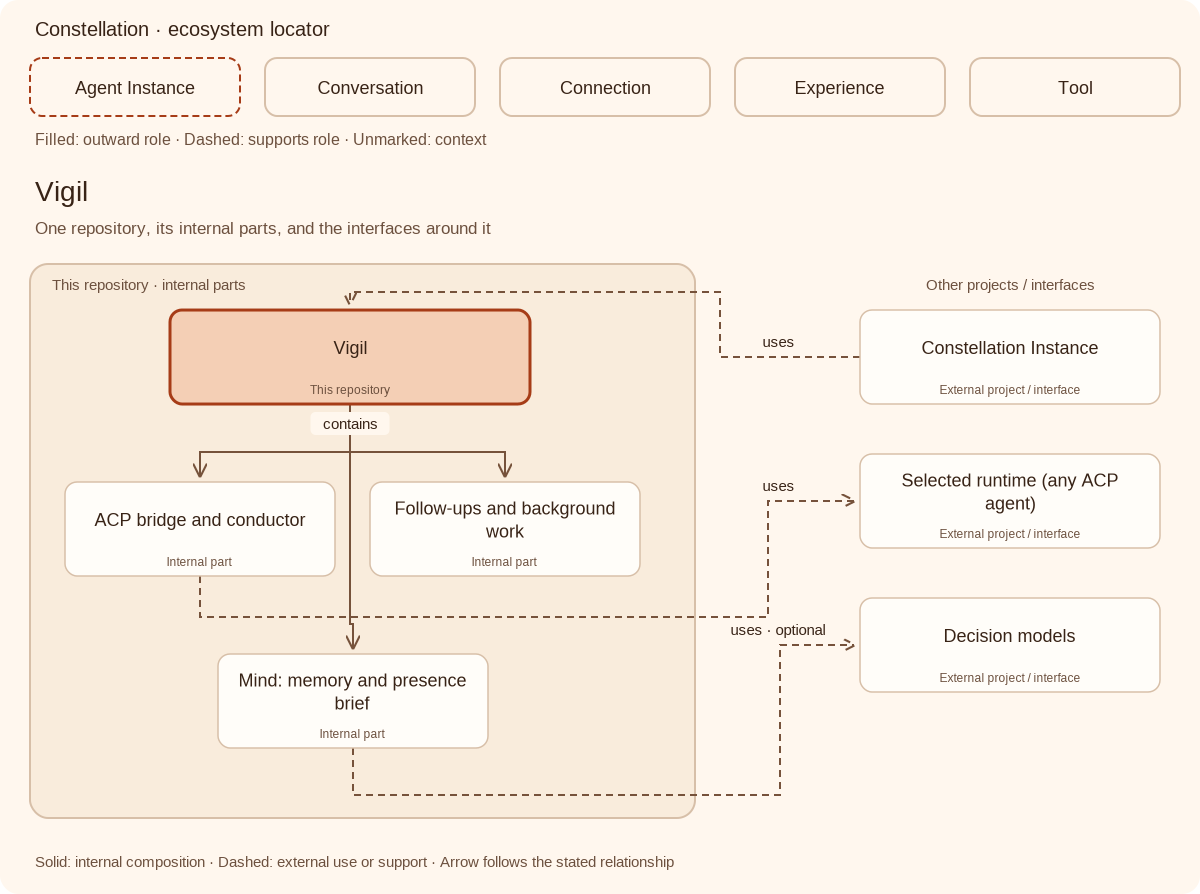
- Constellation Instance uses Vigil.
- Vigil contains ACP bridge and conductor.
- Vigil contains Follow-ups and background work.
- Vigil contains Mind: memory and presence brief.
- ACP bridge and conductor uses Selected runtime (any ACP agent).
- Mind: memory and presence brief uses Decision models (optional).
Get started
You need Linux with systemd user services, Python 3.12 or newer, and a model credential. Run everything as the OS user who owns the agent.
-
Install it for one agent
From a checkout of the repository. This creates a private home with its own Python environment, a pinned and checksummed runtime, and a user service that keeps the daemon awake.
git clone https://github.com/bkrabach/amplifier-constellation-vigil cd amplifier-constellation-vigil bash install.sh --name Polaris --owner-name Ada \ --workspace "$HOME/.local/share/agent-instance/polaris/workspace" -
Choose a model and start
Everything after
--goes to the engine unchanged, so any provider is set up the way the engine's own documentation describes.VIGIL=~/.local/share/vigil/polaris/venv/bin/vigil H=~/.local/share/vigil/polaris $VIGIL --home $H secret model-key --from-env ANTHROPIC_API_KEY $VIGIL --home $H engine init -- --provider anthropic \ --model claude-opus-5-5 --key-env AGENT_MODEL_API_KEY systemctl --user start vigil-polaris $VIGIL --home $H status -
Point an Agent Instance at it
Set the Instance's backend to the bridge command. Slack, Minecraft, Conversations and the rest keep attaching to the Instance exactly as for any other agent.
Install the Instance without a backend first. The README has the details.
"backend": {
  "command": "/home/you/.local/share/vigil/polaris/venv/bin/vigil",
  "args": ["acp", "--home", "/home/you/.local/share/vigil/polaris"],
  "env": {}, "secret_env": {},
  "working_directory": "${AGENT_HOME}/workspace",
  "allowed_working_roots": ["${AGENT_HOME}/workspace"]
}
What to know first
Vigil is a young project, at version 0.1.34. These are its real edges today.
- Experiences decide when the agent speaks
- No Constellation experience lets an agent post on its own. Vigil reaches a quiet conversation through its connector's follow-up tool where one exists (Slack, and the game in the connector versions that have it); elsewhere, a held thought is delivered on the next message there or the next time that person talks to the agent.
- Shared memory needs someone in common
- A memory from a shared space surfaces in another place only when a person present was part of it. Across surfaces that requires their accounts to be linked, and Vigil links them only on evidence a surface can vouch for.
- Checked on Linux
- The installer and the service use systemd user units. The same scenario passes with the native engine on Anthropic, OpenAI and Gemini models, and with Claude Agent, Codex, OpenCode and Copilot CLI as the runtime. Gemini CLI passes once its workspace is trusted.
The README lists every limit and the design document explains the choices behind them. Component documentation defines what is available; this page explains the direction.